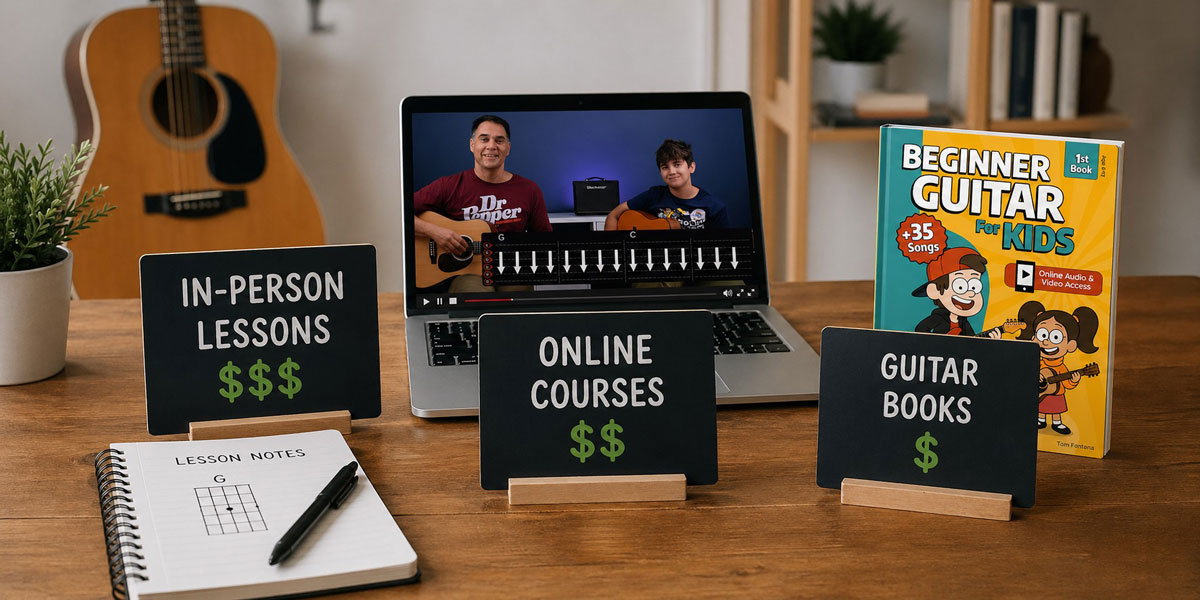
Guitar lessons can run anywhere from $20 a month to over $3,000 a year, depending on how you go about it. And, unlike with pasta, the most expensive route is not always the best one.
If you've done a quick search for kids guitar lesson price in 2026 already and felt some sticker shock, yeah, that's kind of the point here. The price range is genuinely wild, and I think a lot of parents go in not realizing how many options there are. So here's what the landscape actually looks like.
| Learning Method | Monthly Cost | Yearly Cost | Effectiveness Grade | Cost to Value |
|---|---|---|---|---|
| In-Person Lessons (1x/week) | $160–$300 | $1,920–$3,600 | B+ (limited by low frequency) | ⭐⭐⭐ |
| Online Course/Subscription | ~$20 | ~$240 | B+ (great for motivated kids) | ⭐⭐⭐⭐⭐ |
| Books with Audio/Video | ~$20/book | $40–$80 | C+ | ⭐⭐ |
| Books (no extras) | ~$15/book | $30–$60 | D | ⭐ |
In-Person Lessons: The Classic Option
Being a parent shopping for guitar teachers, the prices can be genuinely startling.
Private, in-person lessons across the US run about $40 to $75 per session, depending on where you live and how experienced the teacher is.
Big cities like NY, LA, SF? Expect the high end, easily. In smaller towns or suburbs you might find someone reasonable for less, but those under-$40 teachers are getting rare.
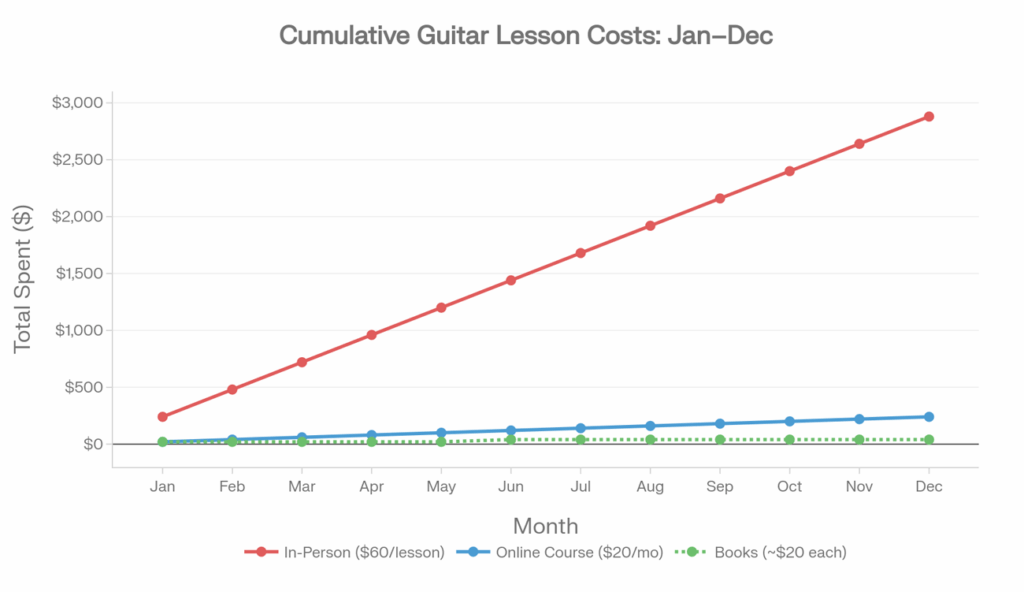
Most families do once a week. Do the math and that's roughly $160 to $300 a month, and over a full year you're looking at $1,920 to $3,600, its not a small number.
Live one-on-one lessons over Zoom are basically in-person lessons but remote. Prices are similar, sometimes slightly lower, not a huge difference.
Plus, even if you own a bank, know that the once-a-week lessons barely build any real momentum. Guitar is a physical skill that needs daily repetition. If a kid only plays during the weekly lesson and maybe goofs around a little at home on weekends, progress is going to be slow.
And a frustrated kid who doesn't feel like they're getting anywhere? They quit. Usually by month three.
Things that push the price even higher:
- Teachers who come to your home vs. you going to them
- 60-minute sessions rather than 30-minute ones
- Instructors with conservatory training or professional stage experience
- Music school overhead vs. an independent teacher working from their living room
Online Courses: Where The Value Shows Up
Subscription-based video courses are a different thing entirely, and their the better deal for most families by a wide margin.
The award winning online kids guitar platform, GuitarPlayground.com charges around $20 a month. Compared to in-person rates, that's a dramatic drop at around $200 a year.
Plus, you can watch 3-4 lessons per week, which is way more practice time than the 1x with a private tutor. And advanced platforms like GuitarPlayground have gamification elements that are built to draw the child back regularly through awards, points, challenges, etc.
Is it as effective as a teacher in the room? Honestly it depends. A motivated 10-year-old who sits down every day can make serious progress. Younger kids who need someone physically there to redirect them every five minutes, maybe not as much.
I think you'll find results vary by kid more than by platform, and that's worth keeping in mind.
The practical upside, beside the cost, is flexibility. No scheduling around soccer practice, no driving across town. Your kid can revisit a lesson three times in a row if they didn't get it the first time.
Guitar Books: Low Cost, Mixed Results
The cheapest option by far. Also the easiest thing in the world to ignore.
Reading chord diagrams off paper without hearing what they're supposed to sound like is a strange way to learn an audio skill, and I've watched people buy beginner books with the best intentions only to see them under a stack of mail by week three. (Not naming names but one of them is me, so.)
That said, books that include companion audio or video material online are a lot better than plain notation-only books.
This roundup of guitar books for kids is worth reading before buying anything. For younger kids, roughly 6-10, this beginner book uses a simple 3-step method with 35+ songs and includes online audio and video, which genuinely makes a difference. For older kids and teens ready to push further, this option ramps up the content while staying approachable.
At about $20 a book, its a low-risk place to dip a toe in. Just don't expect it to carry a kid very far on its own.
Which One Actually Fits Your Kid?
My take: it depends almost entirely on age and personality.
Under 8, total beginner? In-person is probably the right call, at least for the first couple of months. Young kids benefit from hands-on correction and real-time feedback. A teacher spots bad hand positions before they become permanent. You go online, you watch a video, you don't always know what you're doing wrong.
But with that said, a good online course that has parental guidance can produce the same results...
Either way, once the basics are solid, the case for $200/month lessons gets a lot weaker. Switching to an online course at that point may actually produce better results because there's more material to practice with and no week-long gap between sessions.
Books as a supplement to something else works reasonably well, as a standalone plan though it may not get very far unless the book includes audio or video extras and your kid is unusually self-directed.
Mistakes Parents Usually Make
The most common pattern, a family pays for weekly lessons for six months, doesn't see dramatic results, and quits. The teacher was probably fine. The real problem is that 1x per week isn't enough repetition to build a physical skill quickly, especially for younger kids.
Books-only learning tends to fail because without audio feedback, kids can't tell if they're even doing it right. Motivation drops fast once they don't feel progress or any reason to continue. A parent who knows the instrument can be of help here though.
Online courses can drift too. Without some parental involvement, they can go from "structured learning" to "another app nobody opens after week two."
The kids who do well with online courses are the ones whose parents take some interest, ask to hear what they practiced, and treat it like a real activity rather than free babysitting.
A Realistic Budget Plan
If I had to point most parents somewhere right now, it would be an online guitar course.
Around $20 a month for structured lessons, progress tracking, and material your kid can revisit as many times as they need, its hard to argue against that value. A motivated kid can move through content faster than any once-a-week schedule would ever allow.
My suggestion for most families:
- Start with an online course (~$20/month) and give it a genuine 60-90 day run before deciding anything else
- Add a beginner book with audio/video extras ($20 one-time) as a supplement, something your kid can flip through away from a screen.
- Consider in-person lessons if your kid is very young (under 8-9), struggles to focus independently, or hits a specific wall that online material isn't solving.
That last point is worth sitting with a bit. In-person lessons aren't bad, they're just not a great fit for every kid or every budget, and I think a lot of families default to them purely out of habit. For some kids the structured environment makes a real difference, but for most, it may not justify $200 a month when a $20 course covers even more ground with more material.
Starting online keeps the financial risk low. If your kid loses interest by week six (it happens, no judgment) you're out $40, not $400. And if they take to it? You've already got a system that works.