
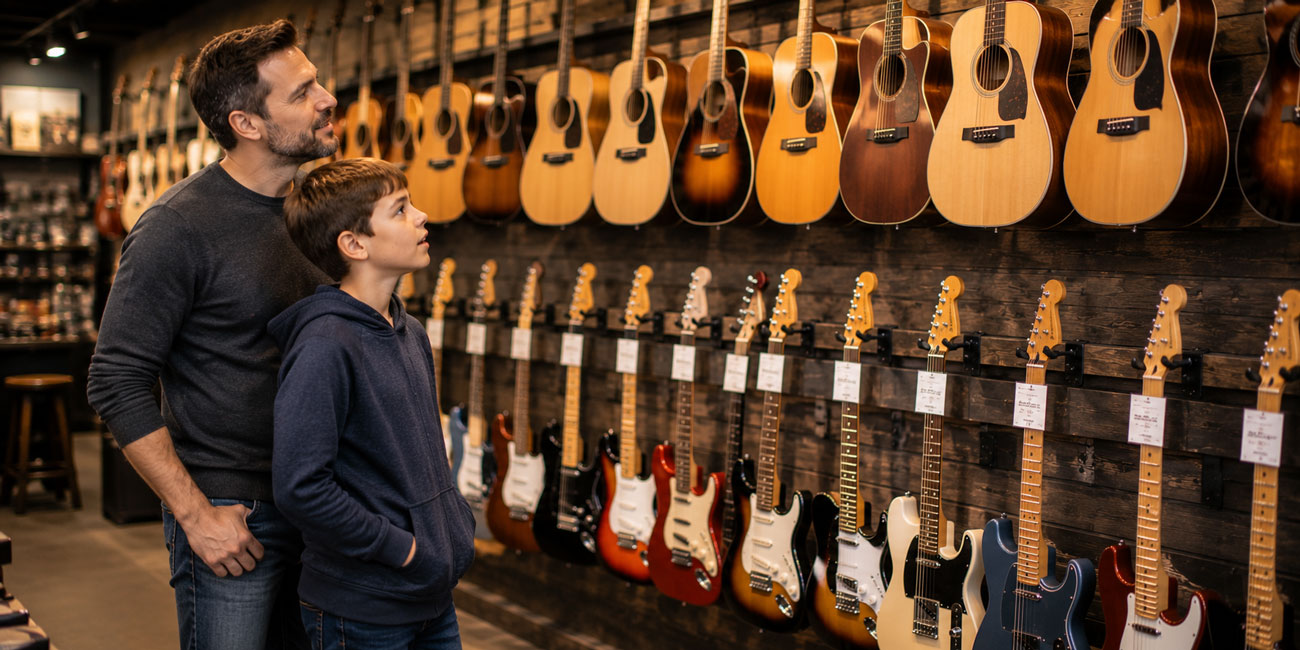
Most parents ask me some version of this before getting a guitar for their kids:
"Can I just grab something cheap? I don't want to spend too much if they end up quitting"
Now I understand the logic, but in my experience as a guitar teacher of +25 years, the quality of that first guitar plays a bigger role in whether a kid sticks with it than parents think.
And the "financial risk" of a decent guitar isn't greater than if they'd get a cheapo one.
Let me explain.
The Resale Math Nobody Tells You
I think this is the most useful thing I can tell any parent before they buy anything.
A decent guitar holds its value. A bad one becomes worthless.
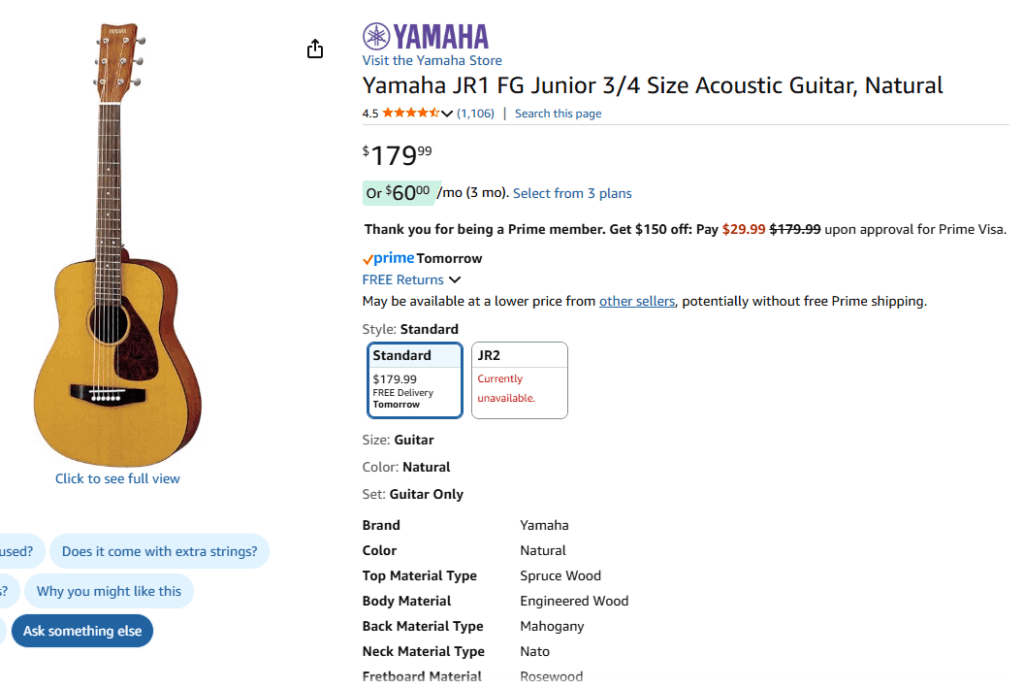
Say you pick up a Yamaha FG JR1 for around $179, a great price value guitar. Your kid tries learning for 6 months, decides guitar isn't for them, you list it on Facebook Marketplace and probably get $100-120 back. Your loss is maybe $60-80, you gave your kid a good chance with quality instrument.
On the other hand, you have the $60 no-name guitar route. Amazon prime warehouse, looks fine in the photo, 3000 reviews, 4.4 star average. But your kid hates playing it (more on why in a second), it sits in the corner for a year. If you try to sell it, nobody wants it, so you're out the full $60, plus your kid never had a real shot at it.
Worst case with a quality guitar: you lose maybe $60. Worst case with a cheap one, you still lose $60, and your kid never stood a chance.
What You Actually Get at Each Price Point
Why Cheap Guitars <$100 Make Kids Quit
This isn't guitar teacher snobbery, I promise, it's industry. Guitars under roughly $150 have real problems that simply make them hard to play and live with.
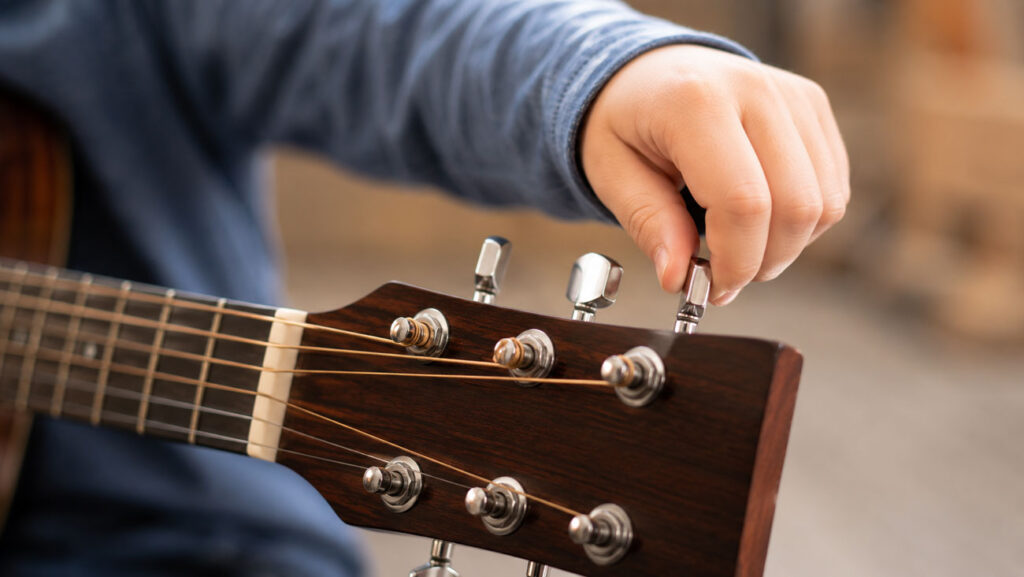
- Tuning slips every few minutes. Budget tuning pegs just don't hold, and retuning every 5 minutes isn't fun.
- Fret ends are sharp. On a lot of cheaper instruments the metal frets stick out slightly from the neck edges. For a kid's fingers, that's uncomfortable enough to make them not want to pick it up, since they irritate their fingers each time they move their hands over the fretwires.
- Intonation is off. Intonation is whether notes stay in tune as you move up the neck, not just on open strings. Cheap guitars often have poorly placed frets or badly cut nuts, so a chord might sound okay at the second fret but noticeably wrong by the fifth. Poor nut height, saddle placement, and fret quality are the most common culprits, and they're exactly what budget manufacturers cut corners on.
I've had students bring me "guitars" their parents found for $50 online. I know immediately. A few chords in and the notes just don't sit right, and there's nothing you can really do about it without basically rebuilding the thing.
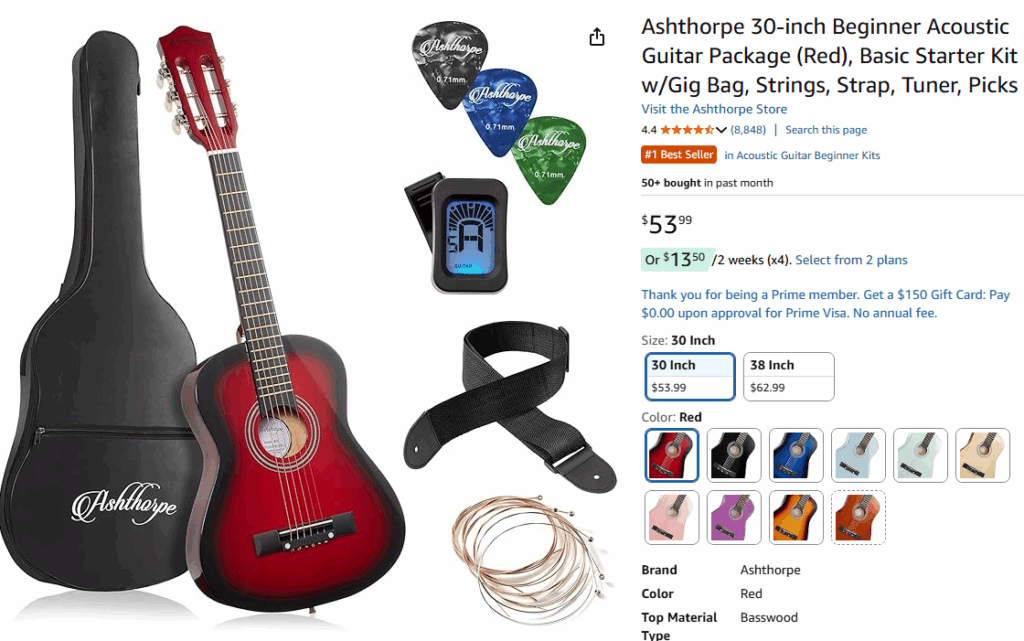
Really, what did you expect? Get all this for $50? Think about the economics:
- the cost of materials, wage of the person in Asia who made it, packaging costs, shipping costs
- the profit expectation of the company who manufactured it
- the retail margin (30-50%), plus Amazon's 15% commission
The math is bad, you can't possibly expect to get a playable instrument.
Working with students on guitars in this range is, honestly, was one of the most frustrating parts of my job.
$100-200 Kids Guitars
Things get more functional here. These guitar are still mass-manufactured, but with better materials and better quality control than sub $100 guitars. The tone is unremarkable but good enough with good strings. I do see quality issues pop up in this range as well, it's almost always the tuners, but nothing severe.
Smaller fractional guitars here tend to have proportion problems too. Bodies that are too deep, fretboards wider than they need to be for small hands, manufacturers compensating for reduced volume in ways that make the guitar harder to play. I've had students bring these in and they pretty consistently have enough small annoyances that I nudge parents to stretch the budget a little if they can.
But you're in luck the Yamaha FG Jr, which is a great beginner kids guitar, is in this price range. It is made out of real wood, the soundboard is not plywood, and it sounds ok. The tuners aren't the best, but you can live with them.
$200-500 Guitars
The two upgrades that matter most here are a solid wood soundboard and better tuners. Solid wood responds to string vibration much more naturally than plywood, so tone and volume both improve noticeably. That's a real difference a kid can hear.
A nice extra I like seeing at this price: rosettes around the soundhole. They look great and they reinforce the wood structurally.
You're usually still getting plywood back and sides, which pulls some of that quality back. Proportion choices can still be a little odd at this range too, but it's less consistent a problem.
$500+ Guitars
I rarely point parents here unless a kid has been playing at least a year and is clearly sticking with it, or if the parent also plays guitar, in which they can just keep it if things don't work out.
At this level you're looking at hand-made instruments where the luthier taps the wood, shaves the braces, tunes the top by ear until it sings. Mass production can't replicate that process, and the tone and volume difference is audible for anybody.
Solid wood throughout, accurate proportions, proper scaling for small hands. These guitars are also beautiful to look at (which I think matters more for kids than adults give credit for, a kid who loves how their guitar looks picks it up more).
There aren't many that fit the role of being a kids guitar since they don't make 3/4 sized ones, but you will find a few smaller body guitar:
- Little Martin (Ed Sheeran plays this exclusively)
- Martin Dreadnaught JR
- Taylor Mini
- Some parlor sized guitars
Recommendations
For most kids, $150-200 is the right range for acoustic. Electric runs $250-290, but remember that the bundle also needs an amp and cable.
As I outline in my article on the best kids guitars, here are the guitars I can recommend:
Acoustic
- Yamaha FG JR1 (~$179) - My top pick, almost every time. 3/4 scale, fits ages 8-12, and Yamaha's quality control at this price point is genuinely good. Guitar World called it "affordable, well-built, and far more playable than its small frame suggests."
My son Milan started on one at age 9. - Taylor GS Mini (~$400+) - If budget isn't a concern and your kid is clearly passionate, or 11 and up, this is a serious guitar. Grown adults play this thing, so it won't become useless in two years.
- Yamaha CGS102 (~$100-130) - For kids under 8, it's genuinely hard to find a small guitar that plays properly. This one does.
Electric
- Squier Mini Strat bundle (~$250-289) - Comes with guitar, amp, and cable. Sounds good, versatile across styles, and Squier has been Fender's student brand long enough that there's real build quality behind it. Not a toy.
- Ibanez Mikro (~$200) - Kids who want to look like they're in a metal band love this one immediately. It looks almost identical to the full-sized Ibanez model, just shrunk down. Solid option if your kid is clearly leaning that direction.
Acoustic vs. Electric: A Note on Budget
Acoustic costs a little less because you skip the amp. That's real. But I'd push back on one thing I hear constantly from parents.
Don't make them go acoustic just because you think that's the "right" way to start.
I had a 13-year-old student whose parents held firm on acoustic, they thought it was the proper foundation. He barely touched it for months. They switched to electric eventually and suddenly he was practicing two hours a day, every day. The best guitar for a kid is the one they actually want to play. (Which sounds obvious, but somehow it's something parents unknowingly resist.)
A Practical Way to Think About It
I think it's best to spend as much as you reasonably can, and think of it as an experiment with a recoverable cost, not a bet. Below roughly $100, you're looking at guitars that go out of tune mid-session and make a learning kid sound bad despite trying hard. That's rough on confidence.
The math usually works out. A quality guitar gives your kid a real shot. If it doesn't stick, you sell it and recover most of the cost. If it does stick, you just made one of the better $60-80 investments of your life.
| Situation | Budget | Why It Works |
|---|---|---|
| Under age 8, not sure yet | ~$100-130 (Yamaha CGS102 ½ size) | Limited small-guitar options anyway, this one is a real instrument |
| Age 8-12, acoustic, testing interest | ~$180 (Yamaha FG JR1) | Legit playability, good resale, Yamaha reliability at this price is hard to beat |
| Age 11+, acoustic, more committed | ~$300-400 (Taylor GS Mini) | Adults can play it too, long-term value, no shelf life |
| Age 8-12, electric, obsessed with a band | ~$250-290 bundle (Squier Mini Strat) | Includes amp and cable, real Fender build quality, holds resale |